
Remembering the Rosary
- catholicindulgence
- Apr 22
- 8 min read
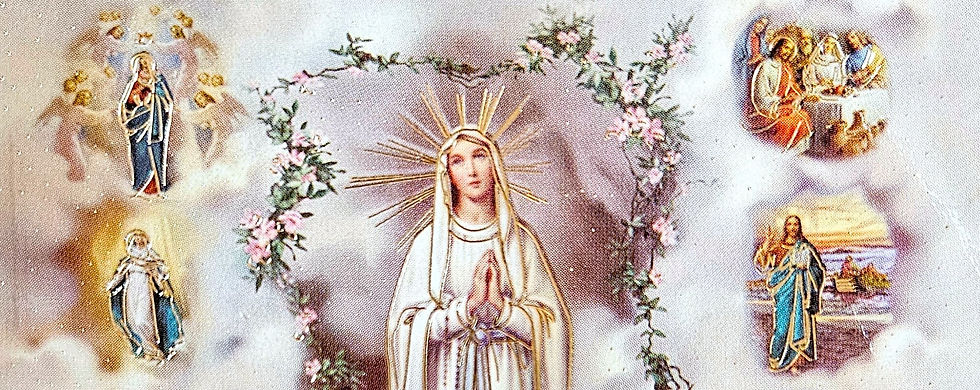
The rosary is one of the most common Catholic devotions today. It is known throughout the world, and it could perhaps even be claimed to be the most popular Catholic prayers today! That being said, the rosary is so common that it enters one of those complexes where it is so well known that it is not always fully explored.
For example, do you know the history of the rosary? Did you know that St. Dominic is accredited with receiving the Holy Rosary from the Blessed Virgin Mary in 1208 in Prouille, France. The Rosary was given to Dominic as a spiritual weapon to convert the Albigensians and combat heresy. This means that Catholics, for approximately 1200 years, did not pray the rosary at all, although there are reports of some saints having devotions consisting of repeated Hail Marys. Originally the rosary consisted of all fifteen decades (the Joyful, Sorrowful, and Glorious). A five decade rosary was known as ‘a third-part of the rosary.’ Lastly, because the definitions are vague, the rosary could be seen as a type of ‘chaplet.’ A Chaplet is broadly defined as a form of devotional prayers, often consisting of a number of prayers that can be tracked on devotional beads. The rosary is distinct, consisting of a specific number of Hail Marys and reflecting on the life events of Mary and Jesus.
Anyway, that’s a little bit of history about the rosary. Is some of this new information to you? If some of it is new, this illustrates that complex I was mentioning, where sometimes something is so common that we often don’t realize that there is still a lot we don’t know about the topic.
As far as indulgences go, the Rosary may be prayed (under select conditions) on any and every day of the year to gain a plenary indulgence. This is fantastic! However, at times this makes it difficult to give the rosary it’s own special attention, leading to a lack of 'teaching' opportunities. So what I want to do with this article it to designate certain days and times to especially acknowledge the rosary. That is, to establish times of “Honorary Rosaries” throughout the year so that we may refresh ourselves of the plenary indulgences that the Rosary offers to us each and every day.
First, let’s refresh ourselves on the Marian Prayer Indulgence Grant (Grant 17)
§1 A plenary indulgence is granted to the faithful who
1° devoutly recite the Marian rosary in a church or oratory, or in a family, a religious community, or an association of the faithful, and in general when several of the faithful gather for some honest purpose;
2° devoutly join in the recitation of the rosary while it is being recited by the Supreme Pontiff and broadcast live by radio or television.
In other circumstances, the indulgence will be partial.
The rosary is a prayer formula consisting of fifteen decades of Hail Marys preceded by the Our Father, during the recitation of which we piously meditate on the corresponding mysteries of our redemption.
Regarding the plenary indulgence for the recitation of the Marian rosary, the following is prescribed:
1. The recitation of a third part of the rosary is sufficient, but the five decades must be recited without interruption.
2. Devout meditation on the mysteries is to be added to the vocal prayer.
3. In its public recitation the mysteries must be announced in accord with approved local custom, but in its private recitation it is sufficient for the faithful simply to join meditation on the mysteries to the vocal prayer.
...
Now, let us look at (and explain) the days to be designated:
The Joyful Mysteries-
March 25th - The Annunciation - The Annunciation is celebrated 9 months before Christmas
May 31st - The Visitation
December 25th - The Nativity - Christmas is celebrated 9 months after the Annunciation.
February 2nd - The Presentation
The Feast of the Holy Family - The Finding in the Temple - The Church does not have a designated day or season dedicated to the Finding in the Temple. Therefore, looking at the Liturgical Calendar, I see that the Finding is read during these masses: The Feast of the Holy Family of Jesus, Mary, and Joseph (particularly during Year C) and it is an optional reading on March 19th for the Solemnity of St. Joseph. For this we will designate the The Feast of the Holy Family as our memorial day for this Mystery.
The Sorrowful Mysteries-
Holy Thursday - The Agony in the Garden - This is the day that we remember Christ’s Agony and Betrayal, the night before the Condemnation and Crucifixion of our Lord.
Good Friday - The Scourging
Good Friday - The Crowning of Thorns
Good Friday - The Carrying of the Cross
Good Friday - The Death and Crucifixion of Our Lord - These four events are all remember on the same day. See the ‘Seasons and Feasts’ category below for an alternative dedication of all of Lent to the Sorrowful Mysteries.
The Glorious Mysteries-
Easter - The Resurrection
40 days after Easter - The Ascension – This falls on a Thursday, however some Dioceses may dispense this feast to the following Sunday. This is a Holy Day of Obligation.
50 days after Easter - The Decent of the Holy Spirit – This is known as the feast of Pentecost.
August 15th - The Assumption – This is a Holy Day of Obligation.
August 22nd - The Coronation - (The new feast of the Queenship of Mary)
OR
May 31st - The Coronation - (The traditional feast of the Queenship of Mary)
Seasons and Feasts-
August 8th - Feast of St. Dominic – He received the Rosary from the Virgin Mary, and especially promoted it's devotion.
October 7th - Feast of Our Lady of the Rosary – This Feast was originally established as the feast of Our Lady of Victory, commemorating the 1571 naval Battle of Lepanto. This defeat was accredited to the widespread praying of the rosary for this intention. Shortly after it was established, the feast was changed from ‘Our Lady of Victory’ to ‘ Our Lady of the Rosary.’
All of October – The Church traditionally dedicated every month of the year to some aspect of faith. The Month of October is dedicated to the Holy Rosary. During this time, especially on dates around Oct 7th, the Pope may pray the rosary publicly, which offers a plenary indulgence.
The Season of Lent – During the season of Lent we reflect on the Passion and Death of our Lord. This season encompasses a period of reflection upon the whole of the Sorrowful mysteries. For the purpose of spreading the Sorrowful Mysteries out, I may designate the weeks of Lent as an alternative time to focus on each individual mystery.
The Season of Advent - During the season of Advent we reflect on the Pregnancy and Birth of our Lord. This season encompasses a period of reflection upon the whole of the Joyful mysteries. For this reason, I may designate the weeks of Advent as an alternative reflection on some or all of the Joyful Mysteries.
You may note that there has been no mention of the Luminous Mysteries of the rosary. Although many sources promote the Luminous Mysteries (even priests, and even for a plenary indulgence) I am hesitant to promote these mysteries of the rosary as able to gain a plenary indulgence for several reasons. Firstly and primarily because the text of Grant 17 does not imply the Luminous mysteries to be apart of the plenary guidelines. The guidelines say ‘a third part of the rosary,’ where if the Luminous Mysteries were intended to be appartof this it should/would say ‘a fourth part of the rosary.’
'Perhaps this is just old/outdated text?' you may think. I wondered that too. However, the last revisions to the Manuel of Indulgences (the book where we get the information of Grant 17) was done in 2006, where documents form 2002 were added to establish the Divine Mercy indulgence and grant eparchial and diocesan bishops the faculty of imparting the Papal Blessing. The Luminous Mysteries were introduced in 2002, so it’s not unreasonable to think that if Pope John Paul II had intended the Luminous Mysteries to join the traditional rosary in offering a plenary indulgence, it could have been amended into the Manuel of Indulgences with a decree.
Furthermore, Norm 12 states: “According to the mind of the Sovereign Pontiff grants of indulgences for all the faithful take effect only after authentic copies of these grants have been examined by the Apostolic Penitentiary.” So, because there is no official approval of the Luminous Mysteries join the traditional rosary, it would be 'against the rules’ for me to promote them.
With all of this said, I do what to recognize: if you have heard from a priest or other ecclesiastic authority that the Luminous Mysteries do offer a plenary indulgence in the same way the traditional rosaries do, well, to put it bluntly, they are presumably wrong. However, I would not begrudge them. As I have come to learn, priests are humans too. They have their own speculations, awareness, and thought processes. I have had several personal occasions where priests have given me inaccurate information on indulgences, but I know they were not doing it out of malice.
Also, if you have been given this advice from a priest or other authority to pray the Luminous Mysteries for an indulgence, then that leads into the second thing I want to address: that is, by their advice, you still have gained a partial indulgence. Although the Luminous rosary is not an approved format of a plenary-bestowing rosary, it still consists of approved Marian prayers, and would offer a partial indulgence instead.
Perhaps some day the Luminous Mysteries will be amended into the Manuel of Indulgences. In the mean time, and just for fun, here are the days that would correlate with each of the mysteries. This is just for the sake of addressing the partial indulgences this ‘rosary.’ And also in case, some day, it is amended.
The Luminous Mysteries-
January 6th - The Baptism of the Lord – This is the traditional day set to celebrate the baptism. However some Dioceses may dispense this feast to an alternative week day or Sunday.
January 6th - The Wedding at Cana - This is also the traditional day set to celebrate the miracle of Wedding of Cana. However, as mentioned above, some Dioceses may dispense this feast to an alternative week day or Sunday. Often, if dispensed, it is to separate these events so that one is celebrated earlier than the other.
The Last Sunday before Advent - The Proclamation of the Kingdom – This is an overarching theme of the faith. However, the Solemnity of Our Lord Jesus Christ, King of the Universe impresses particularly the Christs Kingdom and Kingship.
August 6th - The Transfiguration – This is celebrated on a Thursday. Some Dioceses may dispense this feast to an alternative Sunday.
Holy Thursday - The Institution of the Eucharist – On the night of the Agony and Betrayal of Jesus, right before his Passion, Christ ate with his disciples and there instituted the Eucharist.
So ther you have it! If you follow the calander on this website, or the Catholic Indulgnece Information Meta/Facebook page, I will be instetuting these days as days of 'Honorary Rosaries.' I hope that you have found this helpful. That it has given you more knowledge and confidence in exploring the treasure of indulgences.


Comments